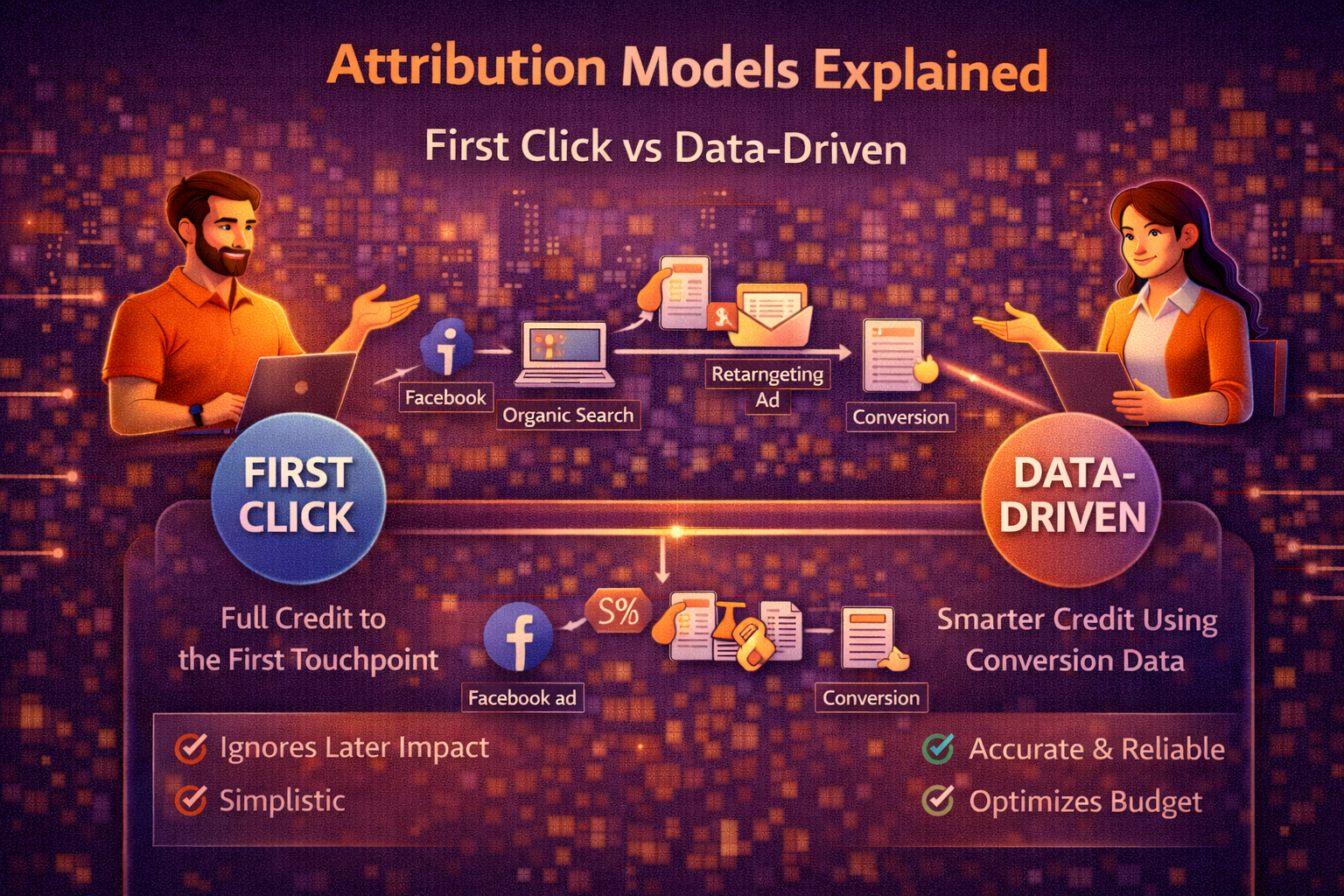
Attribution Models Explained: First Click vs Data-Driven (And Why It Matters for Marketers)
In digital marketing, one of the biggest challenges is not running ads, creating content, or generating traffic. The real challenge is answering a very important question:
Which marketing effort actually brought the conversion?
A user may see your Instagram ad, then read your blog, click a Google search result, receive an email, and finally convert after a retargeting ad. So… who gets the credit?
This is where attribution models come into play.
Understanding attribution is now a must-have skill for marketers, especially for students learning through digital marketing courses in Pune or professionals upgrading their skills in digital marketing courses in Pune with placement, because modern marketing is no longer guesswork — it is data-driven decision making.
Let’s break this down in a simple, practical way.
What Is an Attribution Model?
An attribution model is a rule or framework that decides how credit for a conversion is assigned to different touchpoints in a customer journey.
Imagine this journey:
-
User sees your Facebook Ad
-
Searches your brand on Google
-
Reads a blog post
-
Clicks a retargeting ad
-
Fills the enquiry form
Now the question is:
Which step caused the conversion?
Different attribution models answer this differently.
Why Attribution Matters in Digital Marketing
Without attribution:
-
You don’t know which channel is profitable
-
You may waste money on the wrong platform
-
You might pause campaigns that are actually influencing conversions
-
Your ROI calculations become misleading
This is why attribution is heavily discussed in advanced digital marketing courses in Pune with placement, because companies hire marketers who understand data, not assumptions.
The Traditional Model: First Click Attribution
What is First Click Attribution?
In First Click Attribution, 100% of the conversion credit goes to the first interaction the user had with your brand.
Using the earlier example:
If the user first clicked a Facebook ad, Facebook gets 100% credit.
Even if Google Search, blog content, email, and retargeting influenced the user later — they get zero credit.
When First Click Makes Sense
This model is useful when:
-
You want to know which channel creates initial awareness
-
You are focusing on top-of-funnel marketing
-
You are analyzing brand discovery campaigns
Limitations of First Click
The problem is simple:
It ignores the entire decision-making journey.
In reality, users don’t convert after the first touch. They research, compare, and revisit.
So First Click gives an incomplete picture.
You may end up thinking:
“Facebook is giving all my conversions!”
While actually, Google Search and retargeting are doing the heavy lifting.
The Modern Approach: Data-Driven Attribution
What is Data-Driven Attribution?
Data-Driven Attribution (DDA) uses machine learning and historical data to assign credit to each touchpoint based on its actual contribution to conversions.
Instead of fixed rules, it studies patterns like:
-
Which touchpoints usually appear before conversions
-
How different channels influence user behavior
-
The sequence of interactions that lead to results
Google Ads and Google Analytics 4 now promote this model heavily.
How It Works
DDA analyzes thousands of conversion paths and determines:
-
Facebook ad might deserve 20% credit
-
Organic search might deserve 30%
-
Retargeting might deserve 40%
-
Email might deserve 10%
This is far more realistic.
First Click vs Data-Driven: Practical Comparison
| Factor | First Click | Data-Driven |
|---|---|---|
| Credit Assignment | 100% to first touch | Shared based on real impact |
| Complexity | Very simple | AI & data based |
| Accuracy | Low | High |
| Good for | Awareness analysis | Full funnel optimization |
| Decision Making | Misleading sometimes | Highly reliable |
| Used by modern brands | Rarely | Very common |
Why Google Is Moving Toward Data-Driven Models
Google understands user behavior is not linear anymore.
Users:
-
Switch devices
-
Visit multiple times
-
Engage across channels
So rule-based models like First Click, Last Click, or Linear cannot truly represent reality.
That’s why GA4 and Google Ads recommend Data-Driven Attribution by default.
This shift is something every learner in digital marketing courses in Pune must understand because this is how modern marketing performance is measured.
Real Example to Understand the Difference
Suppose you run campaigns for a training institute.
A student:
-
Clicks a Facebook ad
-
Searches “best digital marketing courses in Pune”
-
Reads your blog
-
Clicks Google search result
-
Fills enquiry form after remarketing ad
First Click Result:
Facebook gets full credit.
You might increase Facebook budget and reduce SEO.
Data-Driven Result:
-
Facebook: 15%
-
SEO Blog: 30%
-
Google Search: 35%
-
Remarketing: 20%
Now you understand:
SEO and Search Ads are actually driving conversions.
That changes your entire marketing strategy.
How Attribution Affects Budget Allocation
Attribution directly impacts where you invest money.
Without proper attribution:
-
You overspend on awareness channels
-
You underfund conversion channels
-
Your ROI becomes unstable
With Data-Driven Attribution:
-
Budget goes to high-impact channels
-
Campaign performance improves
-
Cost per lead reduces
This is why attribution is a key topic in advanced digital marketing courses in Pune with placement, because companies need marketers who know where to invest.
Attribution in Google Ads and GA4
In Google Ads
You can select attribution models like:
-
First Click
-
Last Click
-
Linear
-
Time Decay
-
Data-Driven
Google strongly recommends Data-Driven.
In GA4
GA4 uses data-driven logic by default to show how channels contribute to conversions.
This helps marketers see the real customer journey.
Why Beginners Get Confused About Attribution
Many beginners only see:
“This ad gave 50 leads”
But they don’t see:
-
Which leads came after multiple touchpoints
-
Which channels influenced the decision
-
Why some ads assist conversions but don’t directly convert
This clarity comes with proper training and practical learning, which is why structured digital marketing courses in Pune focus heavily on analytics and attribution.
The Future of Attribution: AI & Privacy
With cookie restrictions and privacy rules increasing, attribution is becoming more AI-dependent.
Platforms now rely on:
-
Modeled data
-
Machine learning predictions
-
Cross-device behavior tracking
This makes Data-Driven models even more important in the future.
Key Takeaways for Marketers
-
First Click is simple but incomplete
-
Data-Driven reflects real user behavior
-
Attribution decides your budget strategy
-
Google prefers Data-Driven models
-
Understanding attribution improves ROI drastically