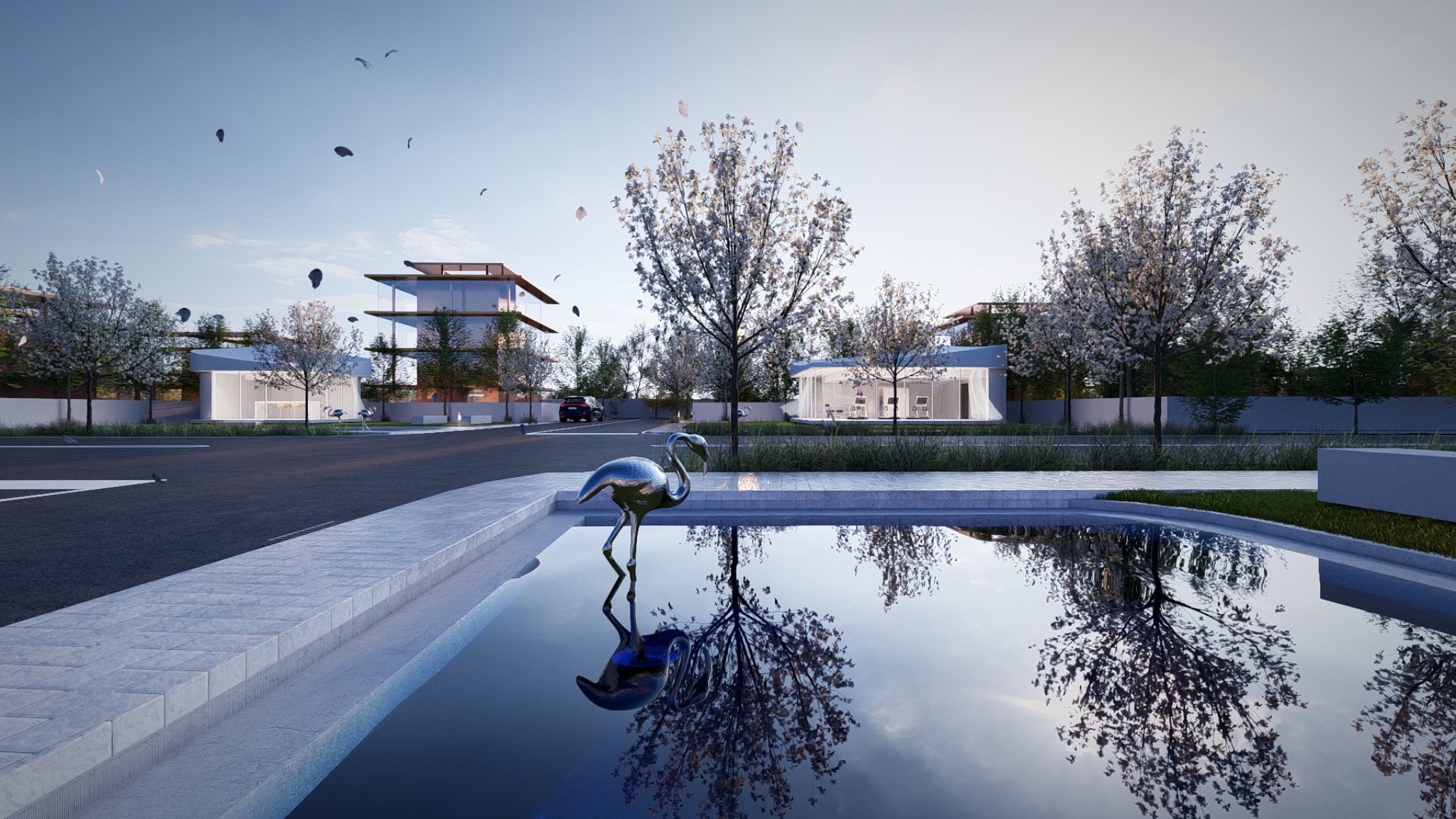
Large mixed-use developments often promise efficiency but struggle in execution. They tend to feel fragmented—collections of offices, retail blocks, and shared spaces placed next to each other rather than designed to work together. Blueprint by Spectacle Realty offers a different perspective. Located in Maharashtra, India, the project demonstrates how thoughtful planning and architectural clarity can turn a large site into a coherent, functional environment built for long-term use.
Currently under construction and spanning approximately 392,040 square feet, Blueprint is conceived as a mixed-use development that prioritises organisation, movement, and everyday usability. Rather than treating architecture and planning as separate phases, the project is the result of an integrated design process that considers how people work, circulate, pause, and interact within shared spaces.
Rethinking the Mixed-Use Model
Mixed-use architecture is often discussed as a checklist—offices, commercial spaces, public zones, and amenities combined within a single site. In practice, however, these elements frequently operate in isolation. Blueprint challenges this pattern by approaching the site as a single system rather than a collection of independent buildings.
From the outset, the development is planned as an interconnected environment. Commercial areas, workspaces, and shared zones are positioned in relation to one another, allowing movement across the site to feel intuitive. Instead of forcing users to navigate confusing layouts, the project relies on logical zoning and clear circulation paths. This reduces congestion and makes daily movement more predictable.
This approach aligns with broader discussions around mixed-use developments in India (internal link), where long-term functionality is increasingly valued over short-term density.
Planning With Clarity From the Start
One of the defining strengths of Blueprint lies in how early planning decisions shaped the entire project. Spectacle Realty’s integrated workflow allowed architecture, planning, and engineering to operate together from the beginning. This made it possible to study access points, circulation routes, pedestrian movement, and future scalability before construction commenced.
Vehicular and pedestrian flows are carefully separated where necessary and combined thoughtfully where interaction is encouraged. Work zones remain efficient and focused, while shared areas are positioned to allow informal connection without disrupting daily operations. This balance is particularly important in large developments, where poor circulation can undermine even well-designed spaces.
Rather than responding to problems after they arise, the planning anticipates how the site will function once fully occupied. This forward-looking approach supports smoother operation and easier long-term management.
Architecture Designed for Use, Not Display
Blueprint does not rely on dramatic forms or visual complexity. Its architectural language is deliberately restrained, allowing function to guide form. The emphasis remains on proportion, accessibility, and spatial efficiency rather than symbolic expression.
This restraint reflects a belief that architecture should support daily use rather than compete for attention. Clear sightlines, well-defined edges, and logical transitions between spaces help users navigate the site naturally. The absence of unnecessary complexity makes the development easier to understand and use, particularly for people who interact with it daily.
Such thinking echoes broader principles of architecture and community planning (internal link), where clarity and usability are increasingly seen as markers of good design.
Flexibility and Long-Term Adaptability
Another important aspect of Blueprint is its focus on adaptability. Instead of being designed for a single moment in time, spaces are planned to evolve as needs change. This flexibility is essential in mixed-use developments, where tenant requirements, work patterns, and commercial uses can shift over the years.
The efficient use of built-up space ensures that areas remain connected and relevant rather than underused. This approach reduces the likelihood of future redesigns and supports long-term sustainability in practical terms. From a management perspective, adaptable layouts also simplify maintenance and operational planning.
For users, this translates into spaces that feel functional rather than rigid—capable of accommodating growth without disrupting the overall structure of the site.
Technology as a Planning Tool
While the design outcome appears simple, the planning process behind Blueprint made extensive use of technology-supported tools. These tools helped simulate movement patterns, study circulation efficiency, and identify potential conflicts early in the design phase.
By analysing how people are likely to move across the site, the team was able to refine connections and optimise layouts before construction. This reduced the risk of costly changes later and ensured better coordination during execution. Technology, in this context, served as a decision-making aid rather than a visual gimmick.
The result is a development where complexity is managed behind the scenes, allowing the built environment to remain clear and legible.
Reflecting a Broader Design Philosophy
Blueprint is not an isolated experiment. It reflects a broader design philosophy that defines Spectacle Realty’s approach to architecture and development. Rather than pursuing a signature style, the firm focuses on process clear planning, responsible design decisions, and coordination across disciplines.
Architecture, planning, engineering, and construction are treated as interconnected parts of a single workflow. This reduces fragmentation and helps maintain design intent through to execution. Awards and recognition may follow, but they are not the primary drivers of decision-making.
In Blueprint, this philosophy translates into a development that feels grounded and realistic. It does not attempt to redefine mixed-use architecture but demonstrates how it can be done well.
A Role in Maharashtra’s Urban Growth
As Maharashtra continues to expand as a commercial and business hub, the need for well-planned mixed-use environments becomes more pressing. Poorly organised developments can contribute to congestion and inefficiency, while thoughtfully planned ones support balanced urban growth.
Blueprint contributes to this larger context by offering an organised, people-focused environment that combines work, commerce, and shared spaces without overcrowding. Its emphasis on clarity and long-term use positions it as a responsible addition to the region’s built landscape.
A Project Defined by Purpose
At every stage, Blueprint reflects intention rather than excess. From early planning decisions to architectural execution, the project prioritises function, adaptability, and coordination. It is designed to work efficiently today while remaining relevant in the years to come.
In a field where scale often overshadows substance, Blueprint by Spectacle Realty stands out for its measured approach. It shows that large mixed-use developments do not need to rely on spectacle to succeed. Instead, clarity, planning discipline, and respect for everyday use can create environments that endure.