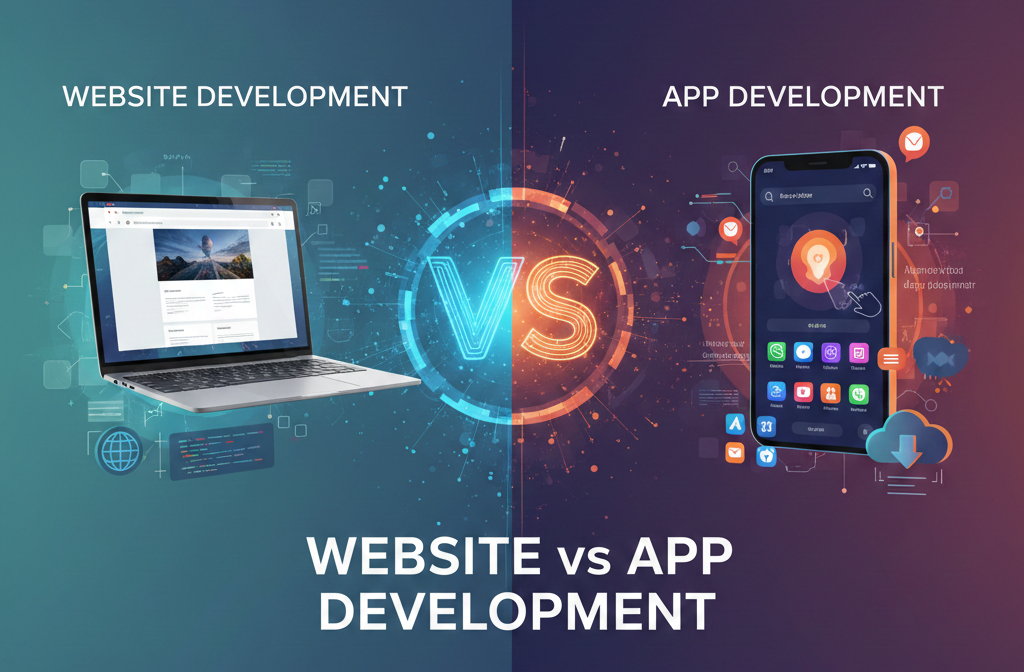
Every business eventually reaches the same digital crossroads. Growth is happening, customers are engaging online, and expectations are rising. At that point, a crucial question appears: Should we invest in a website, build a mobile app, or do both?
This decision is not as simple as choosing what looks modern. A website and a mobile app serve very different purposes. One focuses on reach and discovery. The other focuses on engagement and loyalty. Choosing the wrong option—or choosing too early—can waste time, money, and momentum.
That is why many companies consult a Mobile app development company in USA early in the process to understand what actually supports their business goals, rather than following trends.
This blog breaks down the real differences between websites and apps, how businesses actually use them, and which option works best depending on where a company is in its growth journey.
Understanding the real role of a website
A website is usually the first digital touchpoint for a business. It is open, accessible, and easy to reach. Anyone with a browser can visit it instantly. No installation is required. Because of this, websites are powerful for discovery.
For new businesses, websites answer essential questions. Who are you? What do you offer? Why should someone trust you? These questions matter before any deeper engagement can happen.
Websites also perform extremely well for search visibility. They help businesses attract organic traffic, educate visitors, and generate leads. For many companies, a website is not optional. It is foundational.
Why websites are ideal for early-stage growth
In the early stages, businesses need reach more than depth. They need to be found. They need to explain value clearly. They need flexibility.
Websites deliver all of this. They can be updated quickly. Content can be expanded easily. Marketing campaigns can be launched without app store approvals.
For startups and service-based businesses, a strong website often delivers better ROI than an app at the beginning. It helps validate demand before deeper investment.
Where websites start to show limits
As businesses grow, expectations change. Users want faster interactions. They want saved preferences. They want notifications. They want offline access. At this stage, websites begin to show limitations.
While modern web technology is powerful, browser-based experiences still rely on network conditions and lack deep device integration. As user engagement increases, friction becomes noticeable.
This is often the point where businesses start exploring app development.
The unique value of mobile apps
Mobile apps are designed for repeat usage. They live on the user’s device. They load faster. They remember preferences. They support push notifications and deeper personalization.
An app is not about discovery. It is about commitment. When a user installs an app, they are choosing a brand.
This makes apps powerful tools for retention, loyalty, and long-term engagement.
Apps turn users into regular customers
Businesses that rely on frequent interaction benefit most from apps. Think of banking, fitness, food delivery, learning platforms, or eCommerce.
Apps reduce friction. Logging in becomes seamless. Actions take fewer steps. Payments feel smoother. Over time, the app becomes part of the user’s routine.
That habit formation is difficult to achieve with a website alone.
However, apps are not always the right first step
Despite their advantages, apps are not a universal solution. They require higher upfront investment. They demand ongoing maintenance. They need strong reasons for users to install them.
If a business does not offer repeat value, users will not keep the app. In such cases, an app becomes an unused icon rather than a growth engine.
This is why timing matters.
Websites and apps serve different stages of the customer journey
Instead of asking “website or app,” smart businesses ask, “Which part of the journey are we solving?”
Websites excel at:
- Discovery
- Education
- Lead generation
- SEO visibility
Apps excel at:
- Retention
- Personalization
- Speed
- Habit building
Understanding this difference prevents costly mistakes.
When web applications bridge the gap
In many cases, businesses choose a middle path: a web application.
Unlike basic websites, web apps are interactive, dynamic, and designed for logged-in users. Dashboards, admin panels, booking systems, and SaaS platforms often fall into this category.
At this stage, companies often partner with a web application development company to build scalable platforms that work across devices while avoiding the cost of native apps.
Web apps work especially well for internal tools, B2B platforms, and services used mainly on desktops.
Cost and maintenance considerations
From a business perspective, cost matters. Websites are generally cheaper to build and easier to maintain. Updates are instant. No app store approvals are required.
Apps require more planning. Separate builds for iOS and Android may be needed. Security updates, OS compatibility, and store policies add complexity.
However, apps often deliver stronger long-term ROI when user lifetime value is high.
Performance and user experience differences
Apps typically outperform websites in speed and responsiveness. They can access device features like cameras, GPS, biometric authentication, and offline storage.
Websites rely more heavily on browsers and network speed. While performance can be optimized, it rarely matches native apps for intensive use.
This difference becomes important in use cases where speed and reliability are critical.
Branding and trust perception
There is also a psychological factor. An installed app signals legitimacy and commitment. Users often perceive app-based brands as more established.
Websites build trust through content, testimonials, and design. Apps build trust through daily reliability and performance.
Both matter. They simply work in different ways.
Data, personalization, and insights
Apps allow deeper data collection (with permission). They track behavior more precisely and enable stronger personalization.
Websites still collect useful data, but browser limitations reduce consistency. Apps provide richer insight into user habits.
That insight helps businesses improve products faster.
The smartest approach: not choosing sides
The most successful businesses do not treat websites and apps as competitors. They treat them as partners.
A website attracts users. An app retains them. A web app supports operations. Together, they form a complete digital ecosystem.
Businesses that plan this ecosystem early scale more smoothly.
Decision-making based on business model
There is no universal answer. The right choice depends on:
- How often users interact
- Whether speed and personalization matter
- The role of mobile in the business
- Budget and growth stage
Choosing based on trends instead of strategy often leads to wasted investment.
Real-world example logic
A consultancy may thrive with a website alone. An online marketplace may start with a website, then add an app. A subscription-based service may benefit from an app early.
Context always matters.
Planning for future growth
Many businesses start with a website, validate demand, then expand into apps. This staged approach reduces risk and spreads investment.
What matters is building with scalability in mind from day one.
Final thoughts
Websites and apps are not rivals. They are tools designed for different jobs. Websites help businesses get found and understood. Apps help businesses stay remembered and used.
The smartest strategy aligns technology with user behavior and business goals.
To design a future-ready digital ecosystem that balances reach, engagement, and scalability, working with an experienced iphone app development company helps businesses make informed decisions that support long-term growth instead of short-term trends.
Frequently Asked Questions
1. What is the main difference between a website and a mobile app?
Ans: A website focuses on reach and discovery, while a mobile app focuses on engagement, speed, and repeat usage.
2. Which is better for small businesses, a website or an app?
Ans: Most small businesses benefit more from a website first, as it is easier to launch, cost-effective, and great for visibility.
3. When should a business consider building a mobile app?
Ans: A business should consider an app when users interact frequently and expect personalized, fast, and mobile-first experiences.
4. Can a website and an app work together?
Ans: Yes. Many successful businesses use websites for discovery and apps for retention and loyalty.
5. What is a web application, and how is it different from a website?
Ans: A web application is interactive and designed for logged-in users, while a website mainly shares information and content.